THE POWER OF CREATIVITY
The fact is that God has embedded in us great virtues so much and powerful that when we start to put them to use, we would be marveled at the growth of these virtues. But many have been discouraged by either one circumstance or the other; some have been de-moraled by people around them due to there own failure. The fact is that "the fear of failure will eventually make you a failure" because if you refuse to try new things, if you refuse to climb new heights due to the fear of failing then you remain at that same position meanwhile your counterparts around the world have moved on. I challenge you today, try out those ideas that you have been ruminating on; if you fail at it today, it simply means you should try another method
Read more about Michael Faraday:
Scientific achievements
Chemistry
Faraday's earliest chemical work was as an assistant to
Humphry Davy. Faraday was specifically involved in the study of
chlorine; he discovered two new compounds of chlorine and
carbon. He also conducted the first rough experiments on the diffusion of gases, a phenomenon that was first pointed out by
John Dalton. The physical importance of this phenomenon was more fully revealed by
Thomas Graham and
Joseph Loschmidt. Faraday succeeded in liquefying several gases, investigated the alloys of steel, and produced several new kinds of glass intended for optical purposes. A specimen of one of these heavy glasses subsequently became historically important; when the glass was placed in a magnetic field Faraday determined the rotation of the plane of polarisation of light. This specimen was also the first substance found to be repelled by the poles of a magnet.
Faraday invented an early form of what was to become the
Bunsen burner, which is in practical use in science laboratories around the world as a convenient source of heat.
[26][27]Faraday worked extensively in the field of chemistry, discovering chemical substances such as
benzene (which he called bicarburet of hydrogen) and liquefying gases such as chlorine. The liquefying of gases helped to establish that gases are the vapours of liquids possessing a very low boiling point and gave a more solid basis to the concept of molecular aggregation. In 1820 Faraday reported the first synthesis of compounds made from carbon and chlorine,
C2Cl6 and
C2Cl4, and published his results the following year.
[28][29][30] Faraday also determined the composition of the chlorine
clathrate hydrate, which had been discovered by Humphry Davy in 1810.
[31][32] Faraday is also responsible for discovering the
laws of electrolysis, and for popularizing terminology such as
anode,
cathode,
electrode, and
ion, terms proposed in large part by
William Whewell.
Faraday was the first to report what later came to be called metallic
nanoparticles. In 1847 he discovered that the optical properties of gold
colloids differed from those of the corresponding bulk metal. This was probably the first reported observation of the effects of
quantum size, and might be considered to be the birth of
nanoscience.
[33]
Electricity and magnetism
Faraday is best known for his work regarding electricity and magnetism. His first recorded experiment was the construction of a
voltaic pile with seven ha'penny coins, stacked together with seven disks of sheet zinc, and six pieces of paper moistened with salt water. With this pile he decomposed
sulphate of magnesia (first letter to Abbott, 12 July 1812).

One of Faraday's 1831 experiments demonstrating induction. The liquid battery
(right) sends an electric current through the small coil
(A). When it is moved in or out of the large coil
(B), its magnetic field induces a momentary voltage in the coil, which is detected by the galvanometer
(G).

Electromagnetic rotation experiment of Faraday,
ca. 1821
[34]
In 1821, soon after the Danish physicist and chemist
Hans Christian Ørsted discovered the phenomenon of
electromagnetism, Davy and British scientist
William Hyde Wollaston tried, but failed, to design an
electric motor.
[2] Faraday, having discussed the problem with the two men, went on to build two devices to produce what he called "electromagnetic rotation". One of these, now known as the
homopolar motor, caused a continuous circular motion that was engendered by the circular magnetic force around a wire that extended into a pool of
mercury wherein was placed a magnet; the wire would then rotate around the magnet if supplied with current from a chemical battery. These experiments and inventions formed the foundation of modern electromagnetic technology. In his excitement, Faraday published results without acknowledging his work with either Wollaston or Davy. The resulting controversy within the
Royal Society strained his mentor relationship with Davy and may well have contributed to Faraday’s assignment to other activities, which consequently prevented his involvement in electromagnetic research for several years.
[35][36]
From his initial discovery in 1821, Faraday continued his laboratory work, exploring electromagnetic properties of materials and developing requisite experience. In 1824, Faraday briefly set up a circuit to study whether a magnetic field could regulate the flow of a current in an adjacent wire, but he found no such relationship.
[37] This experiment followed similar work conducted with light and magnets three years earlier that yielded identical results.
[38][39] During the next seven years, Faraday spent much of his time perfecting his recipe for optical quality (heavy) glass, borosilicate of lead,
[40] which he used in his future studies connecting light with magnetism.
[41] In his spare time, Faraday continued publishing his experimental work on optics and electromagnetism; he conducted correspondence with scientists whom he had met on his journeys across Europe with Davy, and who were also working on electromagnetism.
[42] Two years after the death of Davy, in 1831, he began his great series of experiments in which he discovered
electromagnetic induction, recording in his laboratory diary on 28 October 1831 he was; "making many experiments with the great magnet of the Royal Society".
[43]
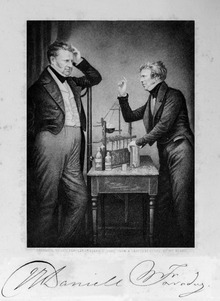
English chemists Michael Faraday (
right) and
John Daniell (
left), credited as founders of electrochemistry today.

A diagram of Faraday's iron ring-coil apparatus
Faraday's breakthrough came when he wrapped two insulated coils of wire around an iron ring, and found that upon passing a current through one coil a momentary current was induced in the other coil.
[2] This phenomenon is now known as
mutual induction.
[44] The iron ring-coil apparatus is still on display at the Royal Institution. In subsequent experiments, he found that if he moved a magnet through a loop of wire an electric current flowed in that wire. The current also flowed if the loop was moved over a stationary magnet. His demonstrations established that a changing magnetic field produces an electric field; this relation was modelled mathematically by
James Clerk Maxwell as
Faraday's law, which subsequently became one of the four
Maxwell equations, and which have in turn evolved into the generalization known today as
field theory. Faraday would later use the principles he had discovered to construct the electric
dynamo, the ancestor of modern power generators and the electric motor.
In 1832, he completed a series of experiments aimed at investigating the fundamental nature of electricity; Faraday used "
static",
batteries, and "
animal electricity" to produce the phenomena of electrostatic attraction,
electrolysis,
magnetism, etc. He concluded that, contrary to the scientific opinion of the time, the divisions between the various "kinds" of electricity were illusory. Faraday instead proposed that only a single "electricity" exists, and the changing values of quantity and intensity (current and voltage) would produce different groups of phenomena.
[2]
Near the end of his career, Faraday proposed that electromagnetic forces extended into the empty space around the conductor. This idea was rejected by his fellow scientists, and Faraday did not live to see the eventual acceptance of his proposition by the scientific community. Faraday's concept of lines of flux emanating from charged bodies and magnets provided a way to visualize electric and magnetic fields; that conceptual model was crucial for the successful development of the electromechanical devices that dominated engineering and industry for the remainder of the 19th century.
That's just a glimpse from Michael Faraday's Scientific Achievement, you can google search more information about him. It is joy!


